What is flex space? A plain-English guide for business owners
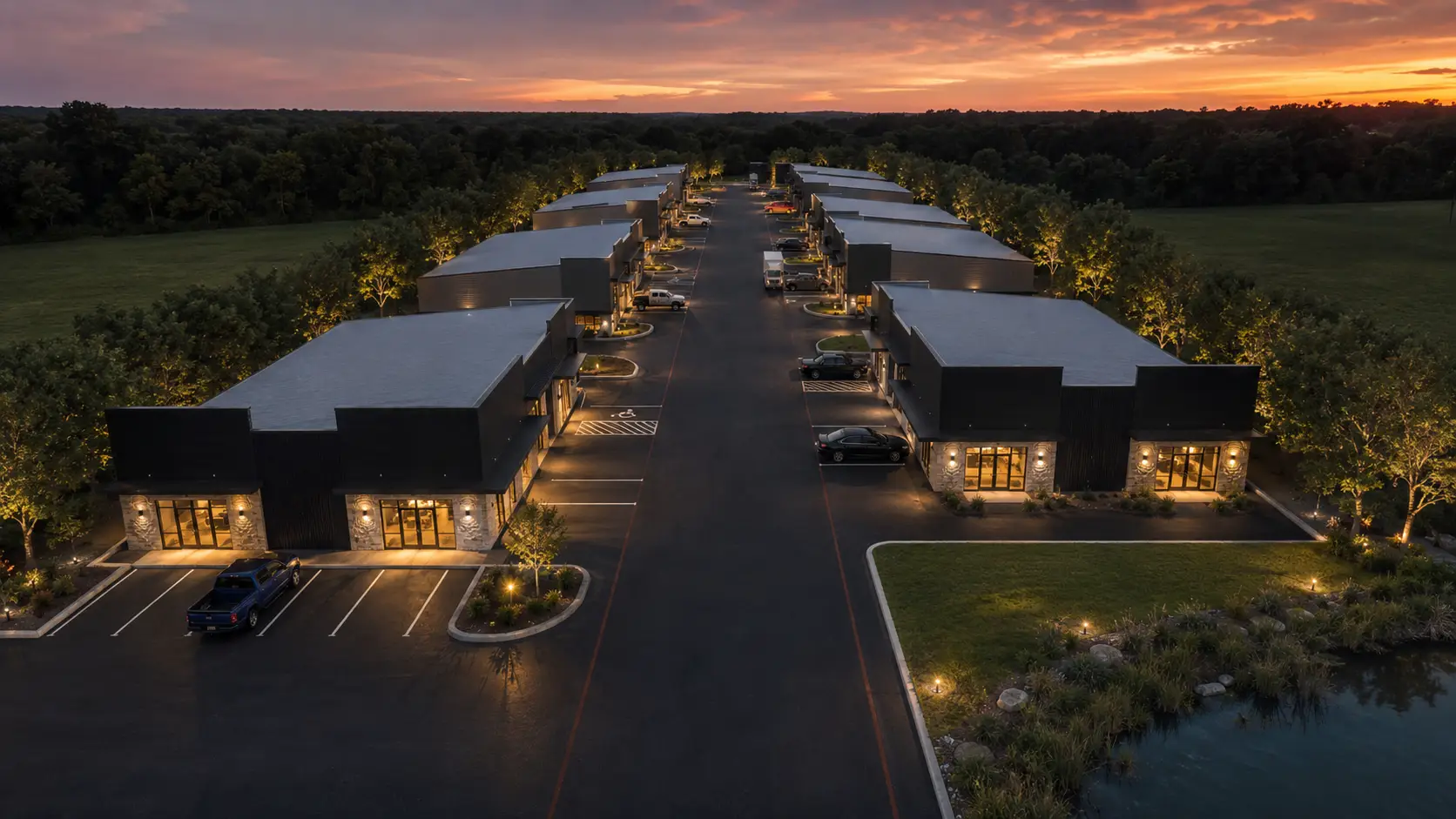
Flex space is commercial real estate that combines warehouse, office, and showroom functions in one unit. A typical small-bay flex unit is 1,500–3,000 square feet with a finished front — glass storefront or office — and an open warehouse bay behind it, accessed by a ground-level roll-up door. One address handles your operations, your admin, and your customers.
If you have ever run a business out of a garage, a storage unit, and a home office at the same time, flex space is the building type designed to replace all three.
What's actually inside a flex unit
- Warehouse bay — open, tall-ceiling space (typically 16–18' clear) for inventory, equipment, or production.
- Grade-level door — a ground-level roll-up door, usually 12×12 or 12×14, so vans and box trucks load without a dock.
- Office or showroom front — a finished, air-conditioned space facing the parking lot for desks, a counter, or product display.
- Restroom and individual HVAC — each unit runs independently; you control your own thermostat and your own utility bill.
- Parking at your door — customers and crews park in front of your unit, not a shared dock court.
Who leases flex space
The tenant mix is wider than most people expect. In our own parks the demand comes from contractors and trades (HVAC, electrical, plumbing, roofing), e-commerce and wholesale businesses that need inventory space plus a desk, service businesses like appliance repair or landscaping, and makers — cabinet shops, sign shops, fabricators. Record small-business formation since 2020 (the U.S. Census Bureau tracks this monthly) is a big part of why these units lease quickly: every new LLC with a truck and inventory eventually needs a roof.
Why it's called "flex"
The name comes from flexibility of use. The same shell can be 10% office / 90% warehouse for a contractor, or 50/50 for a showroom-driven business. Zoning and construction allow light industrial, office, and quasi-retail uses in the same building — which is why the category is also called small-bay industrial or light industrial. Industry groups classify it under industrial, but from the tenant's side it behaves more like a storefront with a warehouse attached.
Why there's so little of it
For the last decade, developers concentrated on huge distribution centers for national logistics tenants, and almost no one built small bays — they're harder to construct and manage per square foot. Meanwhile demand from small businesses kept climbing with the region's growth (the Dallas Fed's Texas economic indicators track it month by month). NAIOP's Development magazine put a number on the shortage in its Spring 2026 small-bay analysis: roughly 23 million square feet of small-bay space under construction nationwide, less than 0.3% of total industrial stock. The result is a structural shortage: in many North Texas submarkets, small-bay flex vacancy runs less than half the overall industrial vacancy rate. That's the gap ScaleUp builds for.
How leasing flex space works
Most flex leases are NNN (triple-net): you pay a base rate per square foot per year, plus your share of property taxes, insurance, and common-area maintenance. We break the full math down — with current North Texas numbers — in how much it costs to lease flex space in DFW. And if you're weighing this category against a bigger box, read flex space vs. traditional warehouse. Once you know the category fits, the next question is sizing — covered in what size flex space your business needs.
FAQ
Is flex space the same as a warehouse?
No. A traditional warehouse is built for storage and distribution at scale. Flex space is a smaller unit that combines warehouse square footage with finished office or showroom space, so one address can handle operations, admin, and customers.
What businesses use flex space?
Contractors and trades, e-commerce sellers, wholesalers, service businesses, makers and fabricators, and growing companies that have outgrown a garage or storage unit but don't need a full warehouse.
What is a grade-level door?
A roll-up door at ground level, so vans and box trucks back straight up to — or drive into — the unit. No loading dock needed, which is one of the biggest practical advantages of small-bay flex.
See flex space in person
ScaleUp builds and leases small-bay flex parks in Rockwall and McKinney, Texas. Units from 1,500 to 3,000 SF, delivering Summer 2027.
Schedule a tour →